If you play CS2 or PUBG seriously, you already know the real problem with finding a group.
You queue with a stranger who swears their peak is better than their current rank, and two rounds in it's obvious they aren't. You look at the scoreboard and wish you hadn't queued with them in the first place. Most Discord LFG bots don't fix that. They may help you find a squad faster, but they dodge the real question: "is this person actually good, or are they going to sell my game?"
That's the difference between a waste of time and a competitive advantage. Below we rank the leading Discord LFG options for CS2 and PUBG on the two things that matter most — whether the skill data is real, and how many players the tool reaches — with real screenshots of what each one actually looks like in Discord. By the end you'll know which tool fits casual any-game pickup play, which fits multi-game server admins, which is the right call for scrims and tournaments, and which is built for players who want the best premades.
What actually changes your games
Every LFG tool can post a "looking for group" message and drop you into a voice channel. That's nice, but it isn't solving the problem. Two things decide whether you end up in a squad worth playing with: verification — is the skill data real — and reach — how many players the solution actually connects you to. Every tool below is graded on both.
Lever one: Verification
What changes your win rate, your ADR, and how much you enjoy the session is who ends up next to you — and whether their skill is real or inflated. There are, broadly, four levels of verification in this space:
This lever is the difference between hoping a teammate is a good fit and seeing that they are.
Lever two: Reach
Verified data is worthless if nobody's there to match with. Reach is simply how many players a solution puts in front of you — and it decides your queue time, how often you find a full stack, and whether you can be picky about skill instead of taking whoever answers. A single perfect profile in an empty room from 2 days ago isn't good enough.
Reach also has levels, and they're mostly a question of where the tool asks you to be active:
The reason this lever is worth as much as verification: activity isn't on platforms, it's on Discord. That's where competitive players already sit every night. Any solution that asks you to go be active somewhere else is starting from a fraction of the pool, however good its data is.
How we grade: each solution below gets a mark on both levers — Verification (A: official game APIs → F: nothing checked) and Reach (A: connected network of Discords → F: a single room). A tool needs both to be worth your queue time.
Discord LFG solutions compared
The whole field graded on the two levers: is the skill data real, and how many players does it actually connect you to?
| Dimension | Plausible LFGVerified competitive | Teamplay.ggMulti-game admin | Gankster.ggScrims & tournaments | CS2 CentralSingle mega-server | Generalist botsAny-game |
|---|---|---|---|---|---|
| Verification grade | Aofficial game APIs Verified, never self-reported | Fnothing checked | Areal verified stats | Fnothing checked | Dreputation, after the fact |
| Reach grade | Aconnected network of Discords | Bcross-server broadcast | Ctheir platform, off-Discord | Cone server, CS2 only | Bbroad but shallow |
| Where the data comes from | KRAFTON (PUBG) + FACEIT (CS2), live | Tags the player picks | Verified profiles on their platform | A rank typed into a chat message | Player ratings after games |
| LFG bot in your Discord | Yes — full LFG inside your own server | Yes | No — their bot is scrims & tournaments only | No — you join their server and post | Yes |
| Primary strength | Verified premades across a network of communities | Multi-game admin automation | Verified profiles + scrims & tournaments | One big CS2 room, always populated | Any-game 1-click convenience |
| Model | Bot in your server + cross-community broadcast | Bot + cross-community discovery | LFG happens on their platform; bot covers scrims only | Join their server, post in LFG, wait | Bot + optional network broadcast |
| Best for | Competitive CS2/PUBG players & communities who want real stats | Admins running multi-game servers | Teams organising scrims & tournaments | Casual CS2 pickup in one big room | Casual, any-game pickup play |
A solution needs a good grade on both levers — verified data in an empty room still doesn't get you a game.
Now the detail — starting with the tool built specifically for the verified competitive niche.
 Best overall
Plausible LFG is built for one job and built to win it: reliable, skill-matched premades for competitive CS2 and PUBG. The decisive difference is where its stats come from.
When you look at a potential teammate's profile, you're not reading a claim they typed — you're reading verified data pulled live from the game's own systems. Unlike tools that rely on self-reported ranks or basic profiles, Plausible pulls live data directly from the games via official APIs, so squads are built on real performance.
Example profile — every stat pulled live from the operator's official API, not entered by the player.
How it works in practice
- Link your account in 3 clicks. The bot displays your real in-game name and live stats — no manual rank entry.
- Set a quick profile — region, language, playstyle.
- Host or join a squad and broadcast it across the connected network, filtered by verified skill.
- Drop into a dynamic voice room — private or open channels created automatically, no clutter, no manual setup.
Because Plausible installs as a bot inside your existing Discord server(s) and connects to a shared network, you reach a larger verified player pool without leaving the community you already belong to. Your members stay home; the reach scales around them. Any community can connect to the network and run the bot in their own server — so instead of one platform's activity, you're matching across all of them at once. You never have to leave your Discord.
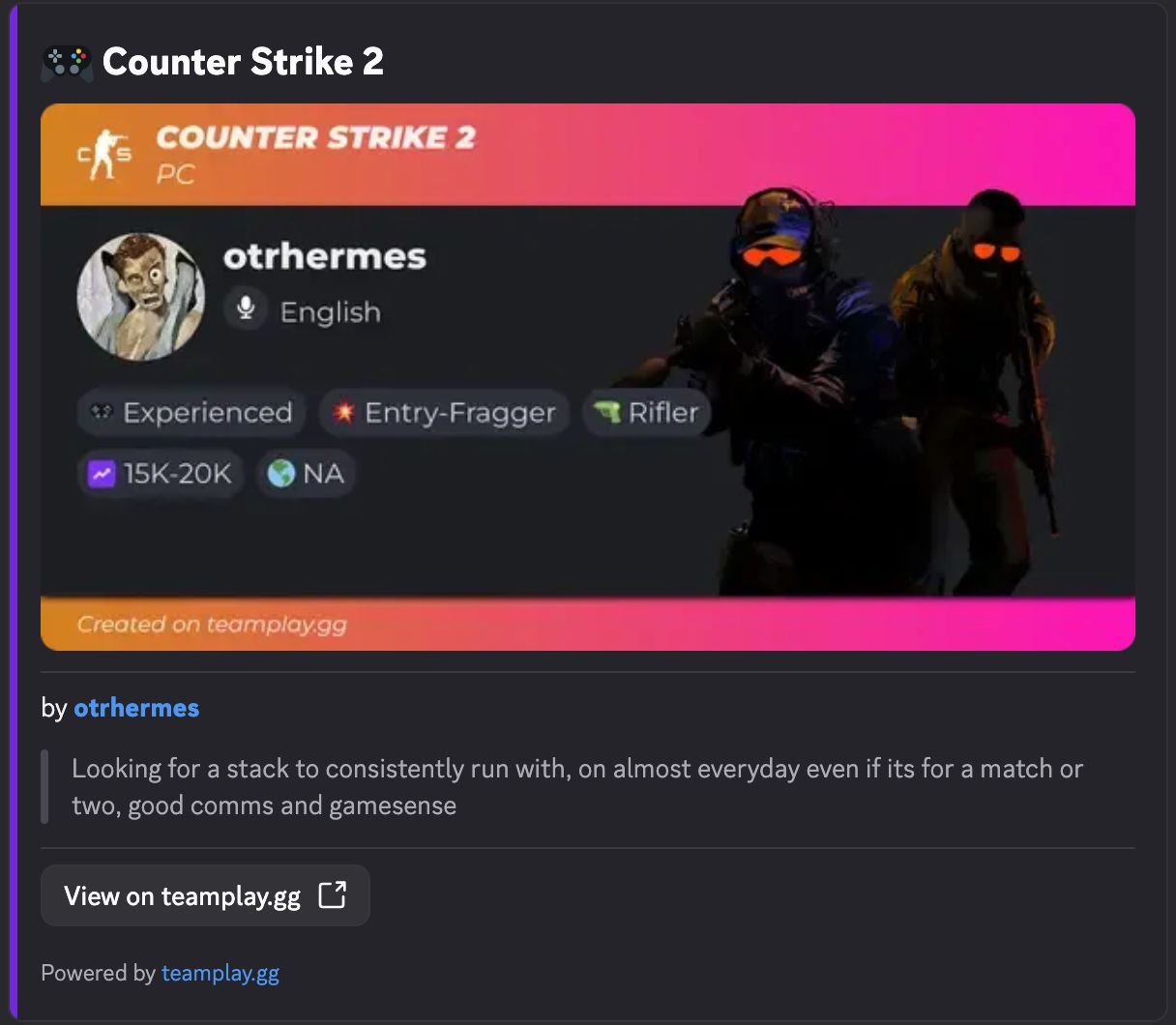
Solid multi-game admin automation — aimed squarely at Discord admins running busy, multi-game community servers. It supports 16+ games including CS2, PUBG, Valorant and Apex, mixing sweaty ranked with chill casual play.
Strengths
Structured LFG posts (game, time, platform, squad size), 1-click join, auto temporary private voice rooms, reminders, and cross-server LFG visibility. Genuinely good automation for a host juggling many titles.
Verification
There is none. The filters look like skill signals — rank, playstyle, vibe — but every one of them is a value the player picked for themselves. Look again at the screenshot above: Experienced, Entry-Fragger, 15K–20K. Nothing on that card is checked against Valve, FACEIT, or KRAFTON. It's a well-designed container for unverified claims, and that's the downfall of the product for competitive play.
Where Plausible pulls ahead: Teamplay.gg earns its B on reach — the cross-server broadcast works. However it's the F on verification that decides it: Teamplay.gg matches on claims, Plausible matches on verified live stats. If you mainly want scheduling automation across a broad multi-game server, Teamplay.gg's tooling fits. If your players care about ranked integrity and want to see real ADR and ELO before they queue, zero verification is the dealbreaker.
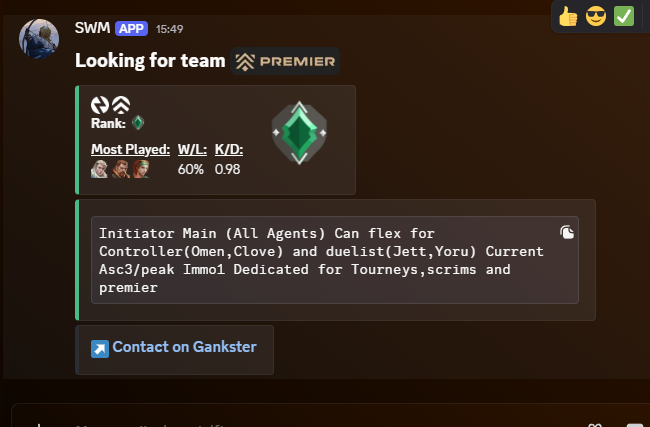
Gankster is genuinely good, and it's one of the few solutions here that takes verification seriously — real verified stats on the profile, not self-typed claims. Its scrim and tournament layer is the strongest in this roundup, and titles like Valorant, Rocket League and LoL are where its scene is deepest.
Strengths
Verified player data, an active scrim and tournament scene, and posts that carry real context — rank, most-played, W/L and K/D alongside a free-text blurb. If you're organising matches between teams, it's a solid tool.
The gap: reach
This is the part worth being precise about. Gankster does not have an LFG Discord bot. The bot they do run is for scrims and tournaments. If what you actually want is to find people to play with — pugs, premades, a regular squad — you have to join their Discord and use their platform.
That caps its reach at a C: your pool is whoever happens to be active on one platform that night, rather than the combined membership of the Discords those players actually live in. Take the Discord layer out of LFG and the pool shrinks no matter how good the profiles are.
Where Plausible pulls ahead: not on verification — Gankster ties Plausible at A there, and deserves to. It's reach that separates the two. Plausible is an LFG bot that installs inside any community's Discord and connects them all into one network, so you never have to leave your server and you're matching across every connected community at once. For scrims and tournaments, use Gankster. For finding people to play with, that's the job Plausible is built for.
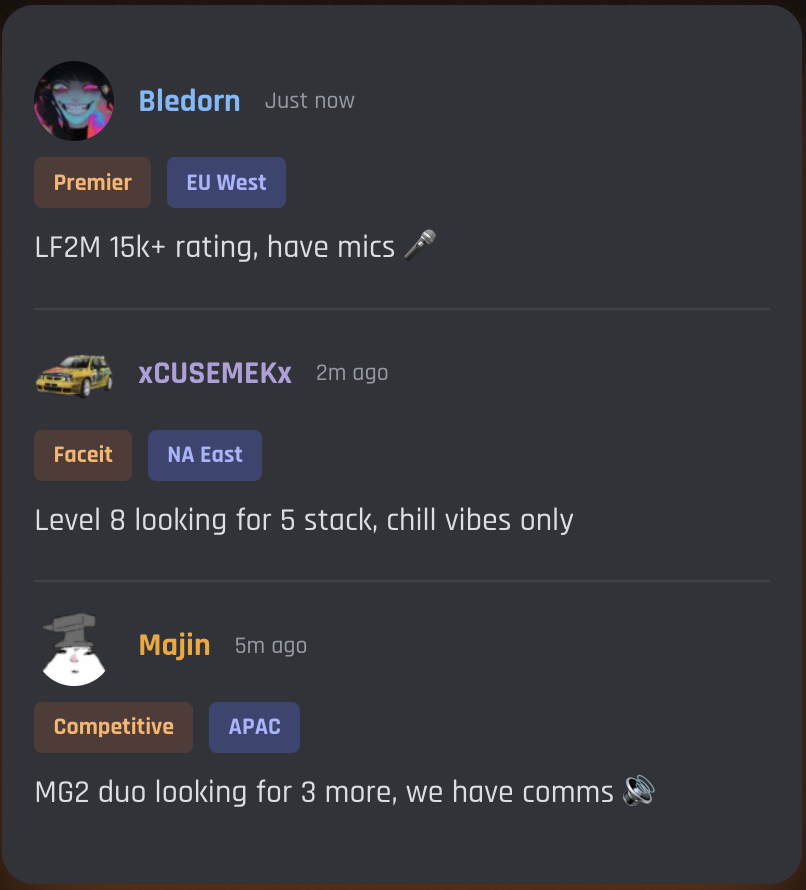
CS2 Central isn't a bot you install — it's one big Discord server you join. Its advantage is raw population: a single well-moderated CS2 hub with enough traffic that something is always being posted.
How it actually works
You join their server, find the LFG channel, and post. Then you wait — and repost when your message scrolls away. There's no matching engine deciding who fits you; the channel is a feed, and visibility goes to whoever posted most recently.
Verification
There is none of any kind. A rating or FACEIT level in an LFG message is simply a number the player typed. Nothing in that channel is checked against Valve's or FACEIT's data, so the pre-queue trust problem is entirely unsolved — you're back to taking a stranger's word for it.
Where Plausible pulls ahead: volume in one room isn't the same as reach, and volume without verification is just a bigger pile of claims. Plausible matches you on live FACEIT and KRAFTON data instead of a self-typed rating, across every connected community rather than a single server — no joining a mega-server, no spamming a channel, no waiting for someone to notice you.
A category of 1-click, any-game LFG bots (including "Just Chatting" use) whose whole pitch is casual convenience. They're built for breadth: post fast, join fast, any game.
Verification, where it exists, is typically a reputation system that only kicks in after games. That's a fine solution for casual pickup play — it's simply a different product from what a competitive CS2 or PUBG player needs. Without authoritative data before you queue, you carry a higher risk of skill mismatch. And skill mismatch, as we'll see next, is where a lot of toxicity actually starts.
Why verified stats and a bigger pool change squad quality
The case for these two levers isn't a feature checklist — it's grounded in how competitive play actually goes wrong. The first two findings below are the evidence for verification; the third is the evidence for reach, and specifically for keeping that reach on Discord.
Skill mismatch breeds toxicity
Research on team-based competitive games consistently locates toxicity in exactly the conditions standard LFG methods create: strangers forced to cooperate under ranked pressure. And the source matters. A large-scale causal study of Call of Duty data found that toxicity from a teammate — the person your matching put next to you — carries a distinct, measurable impact, separate from anything opponents do.1 Survey evidence points the same way: players in competitive shooter and MOBA contexts are among the most likely to experience toxicity, and repeated exposure tracks with real psychological cost.2 In other words, who your system pairs you with is the greatest lever on both your enjoyment and wellbeing.
Better inputs make better matches
Modern matchmaking research treats skill as relative, in-match performance, and stresses that good systems need bounded, predictive, adaptive signals to balance teams and avoid blowouts.3 Crude, single-number self-reports miss most of that — team quality depends on real, composition-aware data, not one inflated rank a stranger typed in.4 Official-API stats like ADR, ELO and live rank are precisely the kind of authoritative input that lets matching do its job better.
Communities are the retention layer
The reason the "keep players in their own server" model matters is that competitive Discord communities aren't just queues — they become genuine social spaces. Studies of Discord's design show it deliberately supports "third place" belonging through persistent, low-pressure, voice-enabled spaces,5 and communities people join to get better at a game reliably evolve into places they stay for the people.6 Team and clan play has long been shown to build real social ties that reach beyond the match itself.7 A tool that strengthens your existing server — rather than siphoning members into a central hub — is working with that grain.
Put together: verified stats produce better-matched squads, a bigger connected pool means you can actually find those squads, and a network that respects the community you already play in keeps them coming back. That's the loop Plausible is built around — and why it's the only solution here graded A on both levers.
- Morrier et al. (2025) — Causal analysis of Call of Duty data isolating the distinct impact of teammate toxicity.
- Zsila et al. (2023) — Survey of toxicity exposure across competitive shooter and MOBA contexts and its psychological cost.
- Activision (2024) — Matchmaking research on bounded, predictive, adaptive skill signals for team balance.
- Nikolakaki et al. (2020) — On composition-aware team quality and the limits of single-number skill estimates.
- Kim et al. (2025) — On Discord's design supporting "third place" belonging via persistent, voice-enabled spaces.
- van Ommen & Yahanashi (2025) — On skill-oriented gaming communities evolving into lasting social spaces.
- Trepte et al. (2012) — On team and clan play building social ties that extend beyond the match.
How to choose the right LFG solution
For serious competitive play in CS2 and PUBG, you want strong marks on both levers — verified data, and a pool big enough to be picky with — without giving up the community you already play in.
Frequently asked
What's the best Discord LFG solution for CS2?
How does Plausible verify PUBG stats?
What does "verified (never self-reported)" actually mean?
Do I have to leave my Discord server to use Plausible?
Is Plausible LFG feature?
How fast is setup?
Which games does Plausible support?
Why does verified matching reduce toxicity?
Ready for real teammates, not claimed ones?
Stop rolling the dice on unverified players. Build squads on stats pulled live from the games themselves — across every community on the network, without ever leaving your Discord.
- Free forever core features
- Verified via official APIs
- Lives in your own Discord